

Key takeaways
- A dust-packed condenser makes the whole system run hot and hard.
- Vibration loosens fittings and rubs hoses through over time.
- After a compressor failure, flush the system and replace the drier and expansion valve.
- Build condenser cleaning and hose checks into the service routine.
A harder life than a ute
A ute's AC gets clean air through the grille, a fairly smooth ride and plenty of time switched off. A machine's system sits in dust, shakes all shift, and often runs flat out from pre-start to knock-off.
It's the same set of parts doing the same job, in conditions that find every weak spot. If you run gear for civil and earthmoving work or plant hire, you may know the pattern: the light fleet carries on without trouble while a loader or dozer needs AC work every summer.
Dust: condensers and filters
The condenser's job is to get rid of the heat the system has pulled out of the cab. On many machines it sits in a stack with the radiator and other coolers, right where the fans drag dusty air through.
Once dust packs into the fins, air can't get through and the heat has nowhere to go. Pressures and temperatures climb, the compressor works harder, and cooling falls away in the hottest part of the day. The national code of practice licensed AC techs work to even lists debris blocking airflow to the condenser as something to note at the start of a service.
Filters cop it too. A blocked cabin or recirculation filter chokes the airflow over the evaporator, so the cab never cools properly, however good the gas charge is.
Vibration: fittings, hoses and brackets
Machines shake all day. Over thousands of hours, that vibration loosens fittings, rubs hoses through where they touch the frame or another line, and cracks the brackets holding the compressor and condenser.
A chafed hose or loose fitting usually leaks slowly before it fails outright. That's the regas that 'didn't last', and it's why a proper leak test matters so much on machinery. Regassing a machine with a slow leak only buys time.
Heat load and long hours
Machine cabs often have a lot of glass and sit in full sun all day. Add engine heat, long shifts and an AC that rarely gets a break, and the whole system works harder than it would in a vehicle doing short trips.
A system that's a little low on gas or a little restricted can get away with it in spring. In a run of hot days there's no margin left, so the weakest machines are the first to leave operators sweltering. Running short of gas also hurts the compressor, because the oil it relies on travels around the system with the refrigerant.
Why compressors fail twice
When a compressor fails internally, it can send metal particles and burnt oil through the system. Bolt in a new compressor without cleaning that out and the debris goes straight back through it. Technical guidance on AC flushing warns that leftover dirt can collect in a new compressor very quickly.
A proper compressor job means flushing the lines and the parts that can be flushed, and replacing the parts that can't, like the receiver drier and the expansion valve. Some condensers can't be flushed clean and need replacing too. Then the oil is set to the right amount, the system is vacuumed and leak tested, and it's charged to spec.
That costs more on the day than a straight compressor swap. It costs a lot less than buying the same compressor twice and losing the machine again. If a machine has been through more than one compressor in a short time, ask what was done the first time. If nobody flushed it or changed the drier, that's likely your answer.
Any of that work on an R134a machine needs a licensed technician. Refrigerant handling licences cover automotive plant and equipment, not just road vehicles.
Practical prevention steps
Most of this is routine maintenance, not specialist work. It just needs the AC treated as part of the machine's servicing rather than an afterthought. A preventative maintenance program can build these checks in, or your own workshop can run them:
- Blow out the condenser and radiator stack regularly, more often on dusty jobs, following the operator manual so the fins don't get flattened.
- Check and replace cabin and recirculation filters on a schedule that suits the site, not just the standard interval.
- At each service, run an eye along every AC hose and line for rubbing, cracking and oily patches.
- Check clamps, P-clips and brackets, and keep lines off sharp edges and hot surfaces.
- Look at the compressor belt and mounts for wear, cracks and movement.
- Have operators report weak cooling straight away, before a slow leak turns into a failed compressor.
- After any compressor failure, insist on a flush and a new drier and expansion valve, not just a swap.
Quick answers
Why does a machine's AC work in the morning but not in the afternoon?
Often it's heat load finding a weak spot: a dusty condenser, a slow leak or a tired fan. It can also be electrical, such as a relay or switch dropping out once things get hot. A check under working conditions is the quickest way to find out which.
Do you work on big machines as well as small plant?
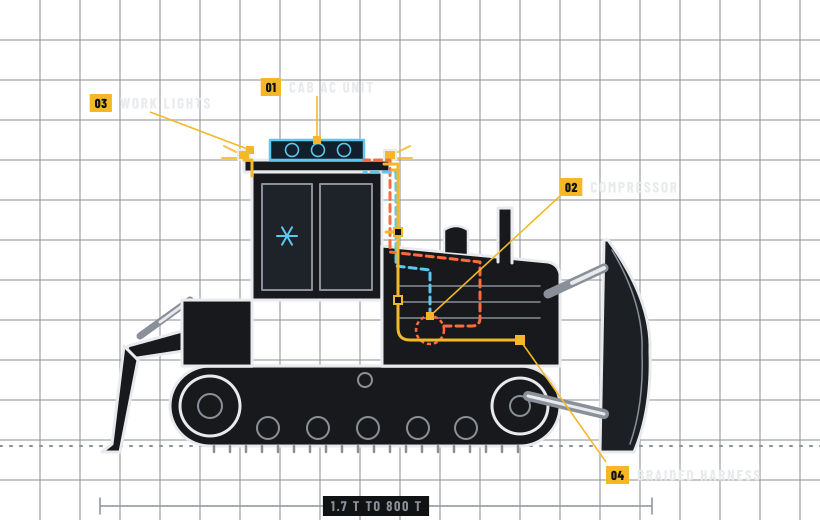
Yes. Our truck and machinery AC work covers machines from 1.7 t to 800 t, from small plant up to large mining gear, at your yard or worksite.
Sources
- Professional Motor Mechanic: What are the key faults that can cause vehicle compressor failure?
- Technical information: Flushing the air-conditioning system and its components
- The Australian automotive code of practice for the control of refrigerant gases in motor vehicle air conditioners (2008)
- Australian Refrigeration Council: Fact sheet 4, automotive air conditioning licence